
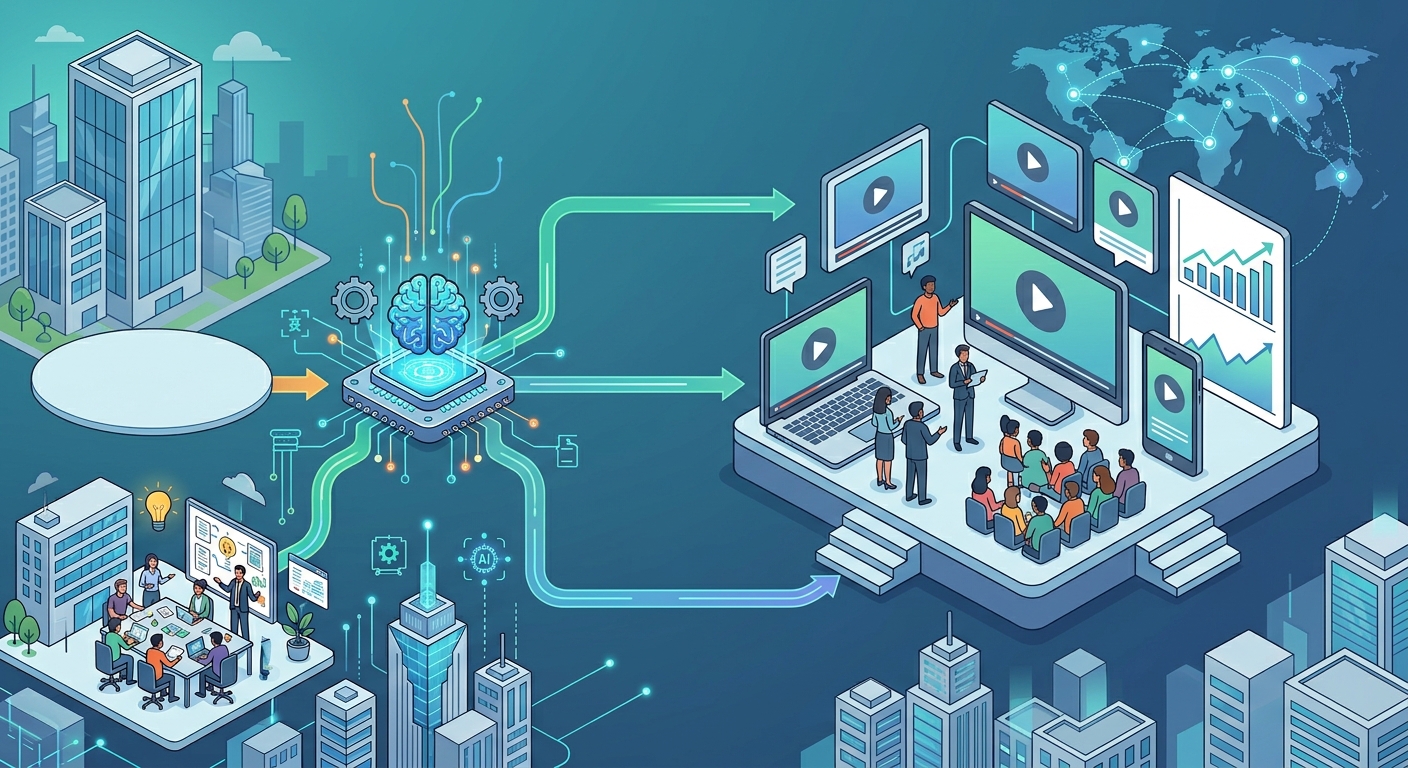
AI video production combines generative visuals, synthetic voiceover, automated editing, and AI localization to produce brand-quality video in days instead of weeks - at a cost that barely rises as volume grows. For enterprise teams that unlocks four use cases: social ad variant packs, localization at scale, evergreen refreshes, and campaign hero videos. This guide covers how it works, where the risks are, and how to pick a partner.
The production timeline that used to take six weeks now takes six days. The brand video that required a full crew, a studio, and a post-production house can now be produced - at the same quality bar - by a team of two.
This is not a future state. Enterprise teams at global consumer brands, SaaS companies, and financial institutions are already using AI video production to change how they plan, brief, and ship content. The ones doing it well are not cutting corners. They are removing friction.
This guide explains exactly how AI video production works at an enterprise scale, what it unlocks, where the risks are, and how to evaluate a production partner who can do it right.
What AI Video Production Actually Means in 2026
“AI video” has become a catch-all phrase that covers a wide range of capabilities. For enterprise teams, it helps to break it down by what AI is actually doing in the workflow:
Generative visuals - AI models generate footage, animation, motion, and character performance from text or image prompts. This replaces stock footage, live-action shoots, and in some cases, traditional 3D animation.
Voice and audio synthesis - AI generates voiceovers in any language, at any tone, from a text script. It also handles music scoring and sound design.
Editing and assembly - AI tools automate cutting, pacing, captioning, and format adaptation. A single master edit becomes 15 platform-specific cuts in minutes, not days.
Localization - AI handles lip-sync translation, voiceover swap, and on-screen text replacement across markets, enabling a single production run to serve a global campaign.
When these capabilities are combined and directed by a skilled production team, the result is not generic content. It is brand-quality content at a speed and volume that traditional production cannot match.
Why Enterprise Brands Are Adopting AI Video Now
The economics are simple. Traditional video production scales linearly - more videos means more budget, more time, more vendor management. AI video production scales exponentially. The effort required to produce one video is almost identical to the effort required to produce ten.
For enterprise marketing teams, this changes what is possible:
- Always-on paid social - Run continuous creative testing with 20, 30, or 50 ad variants without 20x the production spend.
- Localized campaigns - Adapt a single hero video to six markets without six separate production runs.
- Quarterly content refreshes - Keep flagship brand videos current without rebuilding from scratch.
- Speed to market - Respond to a product launch, a cultural moment, or a competitor move in days, not weeks.
These are not marginal improvements. They represent a structural change in what a marketing team can actually execute.
The 4 Core Use Cases for Enterprise AI Video
1. Social Ad Variant Packs
Your creative brief calls for a 30-second hero spot, a 15-second version, a square cut for Instagram, a vertical cut for TikTok, and three audience-specific variants. Traditional production prices that as seven separate deliverables. AI production prices it as one.
A well-structured AI video production workflow produces all of these from a single creative pass. The human direction - the performance, the brand voice, the strategic frame - happens once. The variants are systematic outputs, not repeated work.
Read more: Social Ad Variant Packs - How AI Video Multiplies Your Creative Output →
2. Video Localization at Scale
Global brands spend enormous resources localizing video content - dubbing, subtitling, reshooting, or accepting that some markets simply get older material. AI localization changes this equation.
Modern AI video production pipelines can swap voiceovers, adapt lip sync, and replace on-screen text across multiple languages from a single master. What used to require a localization vendor for each market can now happen inside the same production run.
Read more: AI Video Localization - One Production Run, Every Market →
3. Evergreen Refresh Packages
Every brand has a library of videos that are mostly good but slightly outdated - an old product interface, a discontinued tagline, a voice that no longer matches the brand. Traditionally, refreshing those videos means starting over.
AI production enables surgical updates. Swap the outdated sequence. Re-record the voiceover. Update on-screen text. The underlying structure stays. The video ships as current.
For brands with large video libraries, evergreen refresh is often the highest-ROI entry point into AI video production.
4. Brand Storytelling and Campaign Hero Videos
The use case most people underestimate: AI-generated brand narrative video. Not template-based content. Not stock footage with a voiceover. Fully produced, visually distinct brand films - developed through a human-directed creative process and rendered through AI production tools.
This is where quality anxiety tends to surface, and where the right production partner matters most.
Read more: AI Video Quality - What Enterprise Brands Get Wrong →
What to Look for in an AI Video Production Partner
Most vendors selling “AI video” today are selling tools, not production expertise. The difference is significant for enterprise brands.
Ask about creative direction. The quality of AI video output is almost entirely determined by the quality of the direction going in. Who writes the brief? Who reviews the outputs? Who makes the aesthetic decisions? A production partner without a strong creative point of view will produce average work regardless of which AI tools they use.
Ask about brand consistency. Can they demonstrate multiple videos in a consistent visual style, or does each piece look like it came from a different generator? Brand safety requires systematic quality control across a campaign, not a single impressive demo reel.
Ask about revision workflows. Enterprise approval processes require structured review cycles. How does the vendor handle stakeholder feedback? What does the revision process look like? What is the turnaround on changes?
Ask about rights and IP. Who owns the output? What training data was used to generate the content? Are there licensing restrictions on commercial use? These are not hypothetical questions - they are the first questions your legal team will ask.
Read more: Brand Safety in AI Video Production - A Guide for Enterprise Teams →
The Quality Question
The most common objection from enterprise brand teams: “AI video won’t match our quality standards.”
This objection misunderstands where quality comes from. Quality in video production has never come from the tools - it has come from the decisions made about what to make, how to make it, and why. A cinematographer using a great camera still produces bad footage without vision and craft.
AI is a production tool, not a creative substitute. The brands producing exceptional AI video are doing so because they are investing in creative direction, brand strategy, and quality review - not because they found a better algorithm.
The brands producing forgettable AI video are cutting corners on the decisions that have always determined quality. That was true before AI, and it remains true now.
Sharp Eye Animation has spent over a decade producing award-winning animated video for brands including Walmart, Univision, and Sephora. We brought the same obsession with quality to our AI production capabilities. The timeline changed. The standard did not.
How to Get Started with AI Video Production
The worst approach is a large, high-stakes project as a first engagement. The best approach is a scoped pilot that lets your team evaluate quality, process, and collaboration fit before committing to a full campaign.
A well-scoped pilot typically looks like:
- One hero concept with 3–5 platform variants
- One revision cycle to calibrate quality expectations and feedback workflow
- Final delivery with all formats, aspect ratios, and caption files
From pilot to full campaign, most enterprise teams are making a go/no-go decision within 30 days.
Read more: Inside Our AI Production Process - A Brand Campaign, Step by Step →
If you’re ready to explore what AI video production can do for your brand, start here.
Related Reading
- Social Ad Variant Packs: How AI Video Multiplies Your Creative Output
- AI Video Localization: One Production Run, Every Market
- AI Video Quality: What Enterprise Brands Get Wrong
- Brand Safety in AI Video Production: A Guide for Enterprise Teams
- Inside Our AI Production Process: A Brand Campaign, Step by Step
Speak With A Video Producer Today
Let Sharp Eye Animation create affordable, high-quality video content for your brand!