
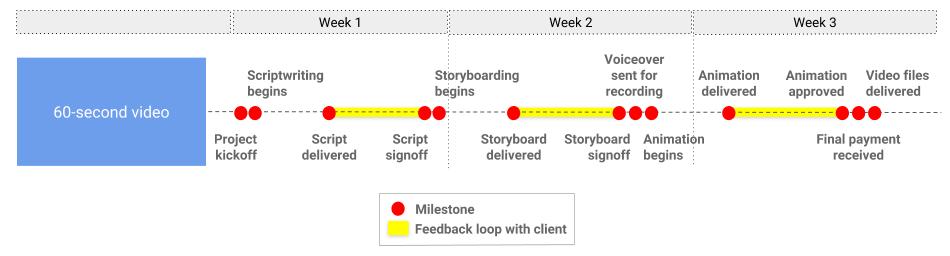
A professionally produced 60–90 second animated explainer video takes 3–6 weeks from kickoff to final delivery. Rush delivery in 2 weeks is possible at a 25–50% premium, and complex 3D projects can run 8+ weeks. Here's the stage-by-stage timeline - and what actually causes delays (hint: it's almost never the animation).
You've got a launch date, a trade show, or a campaign kickoff on the calendar - so before you ask what an explainer video costs, you need to know when you'll actually have it. Here's the realistic answer for 2026.
The production timeline, stage by stage
| Stage | Typical duration | What happens |
|---|---|---|
| 1. Discovery & script | 3–7 days | Kickoff call, messaging goals, script drafts and revisions until you approve |
| 2. Storyboard & style frames | 5–7 days | Scene-by-scene sketches plus designed frames so you see the exact look before animation |
| 3. Voiceover | 2–4 days | Narrator auditions, your pick records the approved script |
| 4. Animation | 7–14 days | The longest stage - scenes are animated, timed to the voiceover, and assembled |
| 5. Music, sound & final delivery | 3–5 days | Licensed music, sound effects, final revisions, and export in every format you need |
Each stage builds on the last: the storyboard follows the approved script, and animation follows the approved storyboard. That's why good studios ask for sign-off at each step - it's what keeps the whole project from unraveling later.
What makes a project run long (it's usually not the animation)
In our experience, the animation itself almost never blows a deadline. These do:
- Slow feedback loops. Every day a script or storyboard sits in someone's inbox adds a day to delivery. Projects with a single decision-maker who responds within 24–48 hours consistently finish on the early end of the range.
- Too many stakeholders, too late. The most expensive words in video production are "legal just saw it." Get every approver - legal, compliance, brand, the CEO - to review the script and storyboard, not the finished animation. Changing a sentence in a script takes minutes; changing it after animation means re-recording voiceover and re-animating scenes.
- Starting without a clear message. If you're still debating positioning during scripting, add a week. Nail down your one core takeaway before kickoff.
- Scope changes mid-stream. "Can we also make it work as a 30-second ad?" is a great idea - at kickoff. Bundled cut-downs planned upfront add days; bolted on later, they add weeks.
How revision policies change your real timeline
Here's the part most timeline articles skip: a studio's revision policy is a timeline issue, not just a cost issue. Studios that cap you at 1–2 revision rounds create a bad incentive - you either rush your feedback to fit the cap or pay hourly for extra rounds while the schedule slips.
We structure it differently: unlimited revisions at every stage, for as long as a stage is under review. You refine the script until it's right, approve it, and we build the storyboard on top of it - and so on through delivery. Approved stages stay locked, which is exactly what keeps the project moving forward instead of circling back. It's a system built for both quality and speed.
Can you get an explainer video in 2 weeks?
Yes - with conditions. Rush delivery works when you bring a near-final script, feedback within 24 hours from a single decision-maker, and a style choice (motion graphics rather than custom 3D) that animates quickly. Expect a 25–50% rush premium, because the studio is reshuffling its production queue for you. If your deadline is real, tell the studio on day one; a good producer will tell you honestly whether it's achievable rather than discovering it in week two.
Timeline and budget go hand in hand
The same levers that shorten a timeline - simpler style, tighter script, fewer revision cycles - also lower the price. For the numbers side of planning, see our 60-second explainer video cost breakdown and the full explainer video pricing guide. And if you're still choosing an approach, start with the 4 types of explainer videos and when to use each one.
Get a real timeline for your project
Tell us what you're making and when you need it, and we'll tell you - honestly - whether the date is achievable and what it takes to hit it. Fast, no-pressure estimate, with four MarCom Awards behind the work.